Bible readings for a funeral or burial service are usually one to three in number: one from the Old Testament or the Psalms, one from the New Testament, and in many churches a Gospel. If your family has been asked to suggest them, this guide lists the passages most often chosen, grouped by what they say, and explains how to choose them, who should read, and how to print them in the programme.
If you want the words in full, see Old Testament readings for funerals, New Testament readings for funerals and, for single verses, Bible verses for funerals.
Ask the minister first
In many churches the minister chooses the readings, or the service book sets them. In others the family may suggest. Ask before you plan.
- How many readings will there be?
- Does the church follow a set list?
- Which translation will be read?
- Can a family member read, or will a church reader?
The minister has the final say on what is read.
Readings of comfort
- Psalm 23. The Lord as shepherd, through the valley of the shadow of death.
- Psalm 46, verses 1 to 7. God as refuge and strength in trouble.
- Psalm 121. Help comes from the Lord, who keeps your going out and coming in.
- Isaiah 40, verses 28 to 31. Those who wait on the Lord renew their strength.
- Matthew 5, verses 1 to 12. The Beatitudes, with the promise that those who mourn will be comforted.
- Matthew 11, verses 28 to 30. Rest for the weary and burdened.
- 2 Corinthians 1, verses 3 to 5. The God of all comfort.
Readings of hope and resurrection
- John 11, verses 21 to 27. Jesus tells Martha that He is the resurrection and the life.
- John 14, verses 1 to 6. Many rooms in the Father's house.
- Romans 8, verses 31 to 39. Nothing can separate us from the love of God.
- 1 Corinthians 15, verses 20 to 26 and 51 to 58. Christ raised, and death swallowed up in victory.
- 1 Thessalonians 4, verses 13 to 18. Not grieving as those without hope.
- Revelation 21, verses 1 to 7. A new heaven and a new earth, with no more death or crying.
- Job 19, verses 23 to 27. "I know that my Redeemer lives."
Readings for a long life well lived
- Psalm 90. Our days, and a prayer for a heart of wisdom.
- Psalm 91. Dwelling in the shelter of the Most High.
- Ecclesiastes 3, verses 1 to 8. A time for everything.
- Proverbs 31, verses 10 to 31. The woman of noble character, often read for a mother or grandmother.
- 2 Timothy 4, verses 6 to 8. The good fight fought and the race finished.
- Psalm 116, verses 12 to 15. Precious in the sight of the Lord is the death of His saints.
Readings for a hard or sudden loss
When the person was young, or the death was sudden, choose passages that are honest about grief.
- Psalm 34, verses 17 to 19. The Lord is near to the brokenhearted.
- Psalm 130. Out of the depths.
- Lamentations 3, verses 19 to 26. Mercies new every morning.
- Romans 8, verses 18 to 25. Present suffering and future glory.
- Revelation 7, verses 13 to 17. God will wipe away every tear.
- Mark 10, verses 13 to 16. Jesus and the little children, sometimes read for a child.
Readings at the graveside
The committal is short. One brief passage is usual, such as John 11 verses 25 and 26, 1 Corinthians 15 verses 51 to 57, or Psalm 103 verses 13 to 17. In many churches the words at the graveside are fixed by the service book.
Pairs of readings that work together
One reading of comfort and one of hope make a balanced service. These pairs are often used.
- After a long life: Psalm 90 or Psalm 91, with 2 Timothy 4, verses 6 to 8.
- For a mother: Proverbs 31, verses 25 to 31, with John 14, verses 1 to 6.
- For a father: Psalm 103, verses 13 to 17, with Romans 8, verses 31 to 39.
- After a long illness: Psalm 121, with 2 Corinthians 4, verse 16 to chapter 5, verse 1.
- After a sudden death: Lamentations 3, verses 19 to 26, with Revelation 21, verses 1 to 7.
- For a young person: Psalm 34, verses 17 to 19, with 1 Thessalonians 4, verses 13 to 18.
- For guests of many faiths: Ecclesiastes 3, verses 1 to 8, with Matthew 5, verses 1 to 12.
How to choose
- Start with the person. Did they have a favourite passage? Was a verse marked in their Bible? Was there one they quoted often?
- Balance the readings. One of comfort and one of hope work well together.
- Keep them short. Six to twelve verses each is enough. Long readings tire a grieving congregation.
- Match the service. A thanksgiving for a life of ninety years reads differently from a funeral for a young parent.
- Check with the preacher. The sermon is often based on one of the readings.
Choosing the readers
A reader should be able to read clearly, slowly and without breaking down. A grandchild, a brother or sister, or a close friend is a common choice. Give them the passage several days before, in the translation the church will use, printed in large type. Ask them to practise aloud.
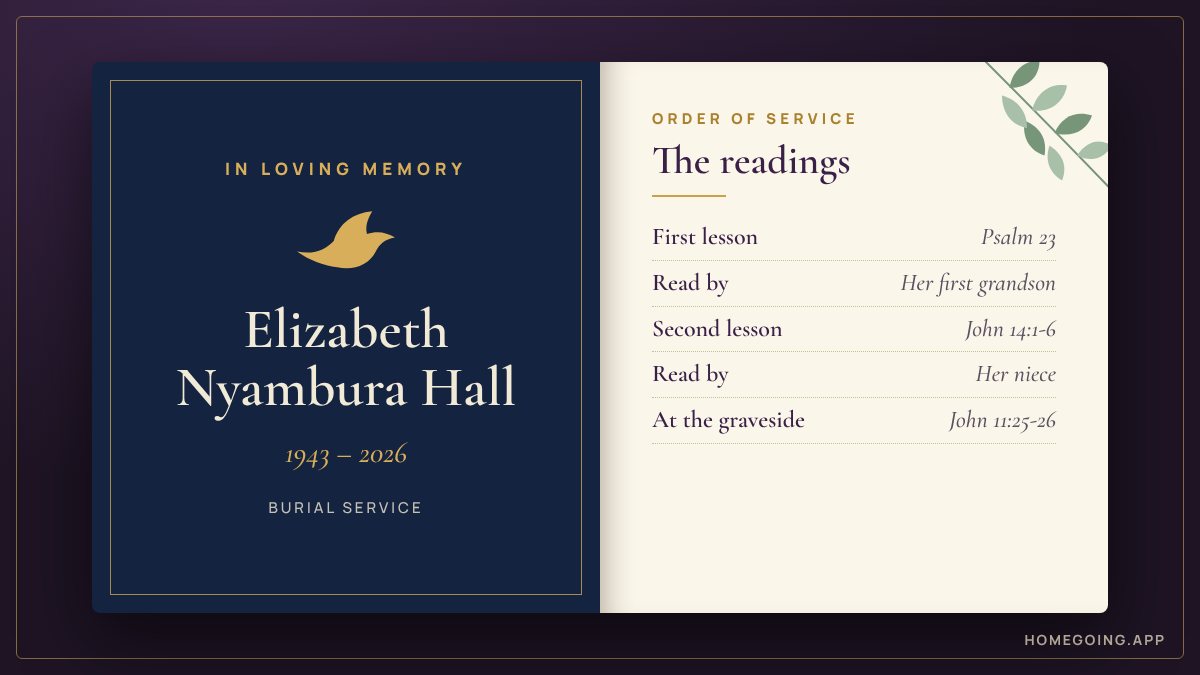
Name each reader in the order of service, for example "First lesson: Psalm 23, read by her first grandson".
What the reader says
Readers often ask how to begin and end. Unless your church has its own words, these are usual.
To begin: "A reading from the book of Psalms, chapter 23."
To end: "This is the word of the Lord." The people answer, "Thanks be to God."
In some churches the reader simply says "Here ends the reading". Ask the minister which your church uses.
How the readings look in the programme
First lesson: Psalm 23
Read by (name), first grandsonSecond lesson: John 14, verses 1 to 6
Read by (name), niece
Printing readings in the programme
You can print only the reference, or the full text.
- Reference only saves space, and suits a congregation that brings Bibles.
- Full text helps guests from other churches follow along.
If you print the text, name the translation. The King James Version is free to print. Most modern translations allow short quotations with a credit line, but each publisher sets its own terms, so check before you print long passages.
A single verse also sits well on the cover or the back page of a programme.
Questions people ask
What Bible readings are used at a funeral?
Psalm 23, John 14 verses 1 to 6, Romans 8 verses 31 to 39, 1 Corinthians 15, 1 Thessalonians 4 verses 13 to 18, Ecclesiastes 3 verses 1 to 8 and Revelation 21 verses 1 to 7 are chosen most often.
How many Bible readings should there be at a burial service?
One to three. Many services have one from the Old Testament or the Psalms and one from the New Testament. Some churches add a Gospel reading, read by the minister.
Who should read the Bible readings at a funeral?
A relative or friend who can read clearly, slowly and without breaking down. A grandchild, a brother or sister, or a close friend is a common choice. The minister usually reads the Gospel.
Which Bible reading is used at the graveside?
One short passage, such as John 11 verses 25 and 26, 1 Corinthians 15 verses 51 to 57, or Psalm 103 verses 13 to 17. In many churches the words at the grave are set by the service book.
Should we print the readings in full in the programme?
Print the reference and the reader's name always. Print the full words if guests may not bring Bibles and you have room. If you print the words, name the translation.
Beside the readings
Hymns carry much of a burial service. See funeral hymns for forty of the best loved, and our hymn pages for words you may print freely. For a funeral Mass, see Catholic funeral Mass readings. For the whole order, see the orders of service for each church, and what goes in a funeral programme.
Build the order of service with Homegoing
Homegoing starts you with an order of service for your church, with readings and hymns already in place. You can change each one, name the readers, and print the hymn words in full. Your minister approves the order before printing. Start a programme