A funeral programme does two jobs. On the day, it helps everyone follow the service. Afterwards, it becomes a keepsake that families hold on to for years. This guide sets out everything a funeral programme can include, gives you a page-by-page template for a short and a long booklet, and shows sample wording for the cover and the order of service.
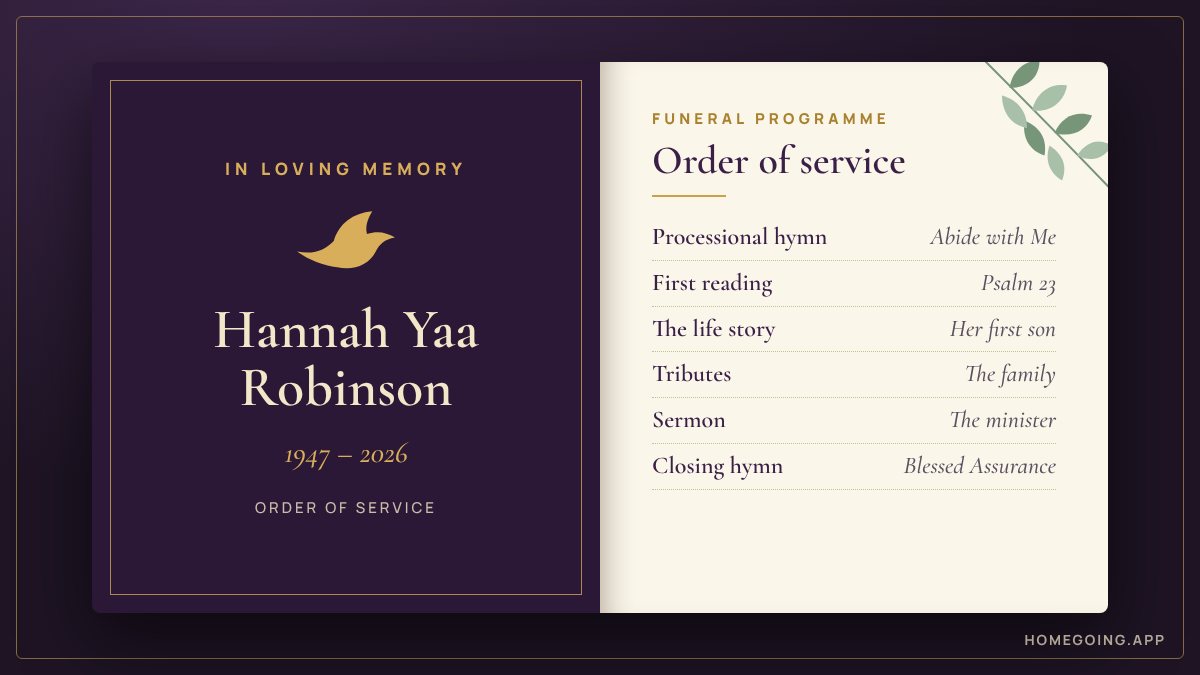
What a funeral programme is
A funeral programme is the printed booklet given to everyone who comes to the service. It carries the order of service, the story of the person's life, tributes, photographs and the family's thanks.
It goes by several names. In the UK it is usually called the order of service. In Ghana it is the funeral brochure. In Nigeria it is the burial programme. In the United States it is the funeral program, the memorial program or the obituary program. Some families call it the funeral booklet. They are all the same thing.
A funeral programme template, page by page
A booklet is made from sheets folded in half, so the number of pages goes up in fours. Choose the size that fits what your family wants to say.
A 4 page funeral programme (one folded sheet)
Page 1: Cover. Photo, name, dates, and the date, time and place of the service.
Page 2: The life story, in about 300 words.
Page 3: The order of service.
Page 4: The family's thanks, the burial place and the reception.
This is the usual size in the UK and North America, and for a small or quiet service anywhere.
An 8 page funeral programme (two folded sheets)
Page 1: Cover.
Page 2: The order of service.
Page 3: Hymns and readings, with the words.
Page 4: The life story.
Page 5: Tributes from the husband or wife, and the children.
Page 6: More tributes, or photographs.
Page 7: Survived by, and the family's appreciation.
Page 8: Back cover. A verse or poem, the burial place and the reception.
This suits most families. It has room for the full words of the hymns and for three or four tributes.
A 12 or 16 page funeral programme
Page 1: Cover.
Page 2: A full-page photograph, or a title page.
Pages 3 and 4: The order of service, with the hymns in full.
Pages 5 and 6: The life story.
Pages 7 to 10: Tributes, in order of closeness.
Pages 11 to 14: Photographs through the years, with captions.
Page 15: Survived by, and the family's appreciation.
Page 16: Back cover.
Long programmes are common in Nigeria, Ghana and other parts of Africa, where a dozen or more tributes may be printed.
The cover
The cover is the first thing people see, and often the page they keep on display at home. It needs very little.
- A clear photo, recent or a favourite from earlier years
- A heading, such as "In loving memory", "Celebration of life" or "Order of service"
- The full name, with any titles the family wishes to use
- Dates of birth and death, or the years only
- The date, time and place of the service
Some families add the age, a short verse, or the words "Sunrise" and "Sunset" beside the dates. Customs differ from country to country, so choose what your family is used to seeing.
Sample cover wording
IN LOVING MEMORY OF
(TITLE AND FULL NAME)
(date of birth) to (date of death)Funeral service
(Day, date), at (time)
(Church or venue, town)
A CELEBRATION OF THE LIFE OF
(TITLE AND FULL NAME)
Sunrise: (date of birth)
Sunset: (date of death)Order of Service
(Church), (day, date), (time)
ORDER OF SERVICE
for the funeral of
(FULL NAME)
(year of birth) to (year of death)(Place, day, date and time)
The order of service
This is the heart of the programme. It lists what will happen, in order, and who will lead each part.
- Entrance music or processional hymn
- Welcome and opening prayer
- Hymns, with the words printed so that everyone can sing
- Bible readings or other readings, with the name of each reader
- The life story, eulogy or tributes
- The sermon or a reflection
- Prayers
- The committal, at the graveside or the crematorium
- Closing hymn, blessing and exit music
A sample order of service
Processional hymn: (title)
Opening sentences and prayer: (minister)
Hymn: (title)
First reading: (reference), read by (name)
Psalm 23, said together
Second reading: (reference), read by (name)
The life story, read by (name)
Tributes: (names)
Hymn: (title)
Sermon: (minister)
Prayers
Offering and thanksgiving
Closing hymn: (title)
Blessing
RecessionalAt the graveside: the committal, a hymn, and the final blessing
Every church has its own pattern, and a non-religious ceremony will look different again. You can compare orders of service by church before you begin. The officiating minister has the final say on the order, so show them the draft before anything is printed.
For the music and the readings, see funeral hymns and Bible verses for funerals.
If there are several events, add a short schedule. This might cover a wake or service of songs, lying in state, the funeral service, the interment and the reception, each with its date, time and place.
The life story and tributes
Most programmes include a biography, sometimes called the obituary or the eulogy. It tells the story of the person's life from birth: family, schooling, work, marriage, faith, and the things they loved. One page is enough for many families. Others run to three or four. Write it from facts the family has agreed, and check every date and place. There is a step-by-step guide in how to write a life story, and a sample biography of a late mother or father.
Tributes are short personal messages from the people who knew the person best. In some countries a programme holds only one or two. In others, such as Nigeria and Ghana, there may be a dozen or more. A common order is:
- Husband or wife
- Children
- Grandchildren
- Brothers and sisters
- In-laws
- Friends and colleagues
- Church, clubs and associations
Give each writer a word limit and a deadline. Head each tribute clearly, and end it with the writer's name. If a relative is unsure where to start, send them tribute to my late mother, tribute to my late father or how to write a tribute.
Family, photographs and thanks
These pages turn the programme into a family record.
- Survived by. A list of the close family left behind: spouse, children, grandchildren, brothers and sisters. Agree together who is named and in what order. This is the page most likely to cause hurt if someone is missed.
- Photographs. A few pages of pictures from different stages of life. Add a short caption to each, with names and the year if you know it.
- Appreciation. A note of thanks from the family to everyone who prayed, visited, gave and travelled. It is also called acknowledgements or a vote of thanks.
- A poem or favourite scripture. One short piece is plenty. Many modern poems are still in copyright, so check before printing the full words.
Sample wording for "survived by"
(He, She) is survived by (his wife, her husband) (name); (his, her) children (names in order of birth); (number) grandchildren; (his, her) brothers and sisters (names); and many nephews, nieces and cousins.
Sample appreciation
The family of the late (title and full name) thanks you most sincerely for your love, prayers and support at this time. We cannot thank each of you one by one, but we ask God to reward you all.
There are more in appreciation messages after a burial.
Practical details for the back pages
The last pages are for information that guests need on the day.
- Officiating ministers, and the choir or organist if you wish
- Pallbearers
- The burial or cremation place
- Where the reception or refreshments will be held
- Donation details, if the family prefers gifts to a charity in place of flowers
- Dress code or family colours
- A link for those watching online
- One phone number for directions
You will not need all of these.
How to make a funeral programme, step by step
- Collect the facts. Full name and titles, dates, the places and times of each event, and the names of the close family.
- Agree the order of service with the minister.
- Choose one cover photo and ten to twenty others.
- Write the life story, and ask for tributes with a word limit and a deadline.
- Choose a design that suits the person: plain, floral, traditional, bright.
- Put the pages in order using the template above.
- Proofread, then show the minister.
- Print, allowing a few spare copies for those who cannot attend.
Size, paper and number of copies
The usual size is A5, which is an A4 sheet folded in half. In North America it is a letter sheet folded in half. Print one copy for every two or three guests at the least, and one each if the family can afford it, because many people take theirs home. See funeral programme size and printing for paper, binding and how to brief a printer.
Before you print
Mistakes cannot be fixed once the copies are made. A few checks prevent most of them.
- Ask two family members to proofread, looking only at names, titles and dates.
- Send the order of service, readings, hymns and speaker names to the minister for approval.
- Check that every hymn printed is the version the church will sing.
- Count the pages. A booklet is made from folded sheets, so the page count goes up in fours: 8, 12, 16 and so on.
- Ask the printer how long they need, and work back from that date.
- Keep a copy as a PDF to send to relatives who cannot travel.
Questions people ask
What should be included in a funeral programme?
The cover with the photo, name and dates, the order of service, the words of the hymns, the life story, tributes, the list of surviving family, the family's thanks, and the details of the burial and reception. Photographs are added when there is room.
How many pages should a funeral programme have?
Four pages is enough for a simple service. Eight pages suits most families. Twelve, sixteen or more are used where many tributes and photographs are printed. The count always goes up in fours.
What size is a funeral programme?
A5, which is an A4 sheet folded in half. In North America it is a letter sheet folded in half, which is 5.5 by 8.5 inches.
What is the difference between a funeral programme and an order of service?
The order of service is the list of what happens at the service. A funeral programme contains the order of service and more: the life story, tributes, photographs and thanks. In the UK the whole booklet is called the order of service.
Who writes the funeral programme?
Usually one or two family members put it together, with the minister approving the order of service. The life story is written by someone who knows the facts, and each tribute by the person who signs it.
How long does it take to make a funeral programme?
Collecting the tributes and photographs takes the longest, often a week or more. Once the words and pictures are in hand, the booklet can be set out in a day. Allow the printer two or three days.
Funeral programmes by country
There are separate guides to the Nigerian burial programme, the Ghanaian funeral brochure, the UK order of service, the US funeral program, and programmes in Kenya and South Africa.
Make the programme with Homegoing
Homegoing is a website that puts all of these parts together for you, on a phone or a computer. You answer a few questions and add photos, and it prepares a print-ready A5 booklet and a phone version to share on WhatsApp. There are 28 designs to choose from. The draft is free to make and carries a DRAFT watermark until you pay once for that programme. Start a programme