If you need to know how to write an obituary or life story for a funeral programme, you do not need to be a writer. You need the facts, a simple order, and someone to check your work. The life story is often the most read page in the programme, and the page families worry about most. This guide takes you through it, with samples to copy.
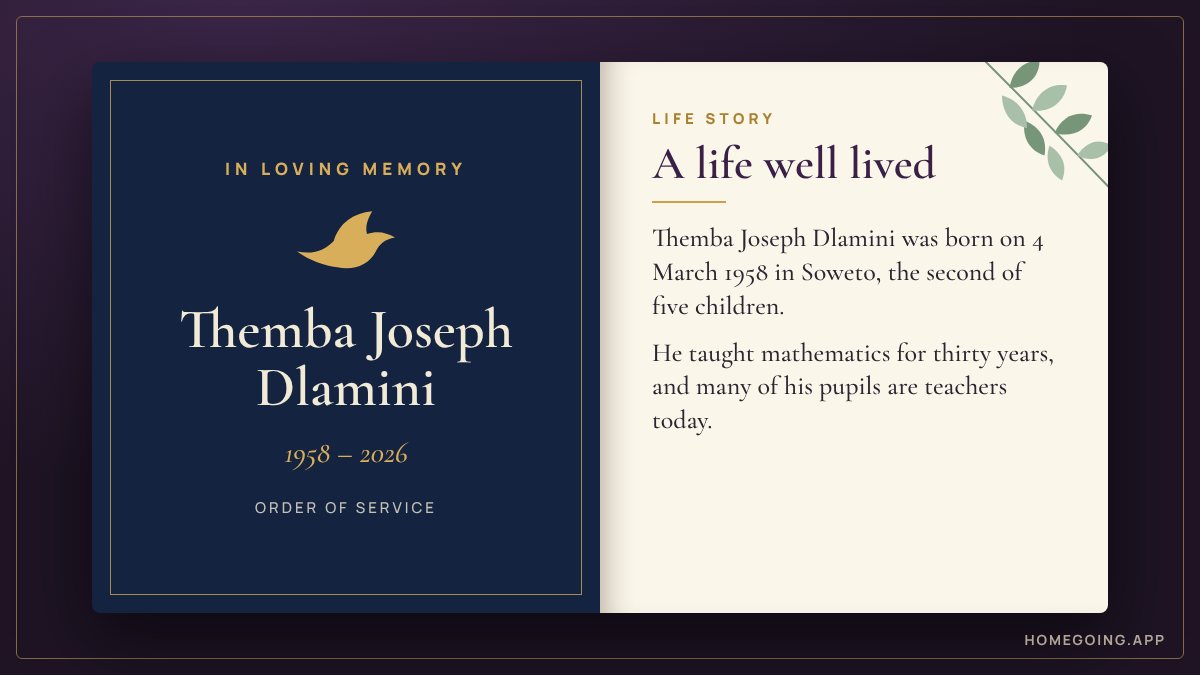
Obituary, life story, biography and eulogy
Families use these words in different ways. This is what each usually means.
- Obituary. A notice that someone has died. It gives the name, the dates, a short account of the life, the family left behind and often the funeral arrangements.
- Life story or biography. The fuller account of the life, printed inside the funeral programme. In the United States this page is often headed "Obituary".
- Eulogy. A speech about the person, given at the service.
- Tribute. A short personal piece from one relative or friend.
Many families write one life story and use it three ways: in full in the programme, shortened for the obituary, and as the base of the eulogy.
Gather the facts before you write
Ask the oldest relatives first, because they remember what nobody else does. A phone call or a voice note is fine. Collect:
- Full name, including names used at home, in church or at work
- Date and place of birth
- Parents' names, and the person's place among their brothers and sisters
- Schools, colleges and training, with rough years
- Work: employers, trades, businesses, posts held, and retirement
- Marriage: to whom, when and where
- Children and grandchildren
- Faith and church life: baptism, confirmation, roles served
- Community roles, titles, clubs and associations
- Interests, habits and sayings that everyone remembers
- The date and place of death and, if the family wishes, a few words about the final illness
Old certificates, letters, church records and photo albums help to settle dates. Where two relatives remember a date differently, look for a document before you choose.
How to write a life story: follow a simple order
Most life stories go from birth to death. That order is easy to write, and easy to follow when read aloud.
- Birth and family. When and where they were born, and to whom.
- Early years and schooling. Where they grew up and studied.
- Work. What they did, where, and what they were known for in it.
- Marriage and children. Their own family, and what kind of spouse and parent they were.
- Faith and service. Church life, community work, and people they helped.
- Character. Two or three qualities, each shown by a small example.
- Later years and passing. Retirement, final days, and the date they died.
- Those left behind. A closing line naming or counting the family who survive them.
You do not need every step. A young person's story will be shorter, and will lean more on character and friendships.
Samples to copy and adapt
Replace the words in brackets with your own details. For a mother or a father, see the sample biography of a late mother or father.
A short obituary for a funeral programme
(Title and full name), aged (age), of (town), died peacefully on (date).
Born in (town) on (date) to (parents' names), (he, she) worked as a (trade or job) for (number) years and was a member of (church). (He, She) will be remembered for (one quality or habit).
(He, She) was preceded in death by (names), and is survived by (wife or husband), (number) children and (number) grandchildren.
The funeral service will be held on (day, date) at (time), at (place).
A life story for a young person
(Full name), known to (his, her) friends as (name), was born on (date) in (town) to (parents' names). (He, She) was the (first, second, last) of (number) children.
(He, She) attended (schools), and was (studying, training, working) as a (course or job) at (place). (He, She) hoped to (plan or dream).
(Name) loved (football, music, church, cooking), and was the one (his, her) friends called when they needed (help, a laugh, the truth). (One small story from a friend or classmate.)
(He, She) died on (date), aged (age). (He, She) leaves (his, her) parents, (brothers and sisters), and many friends who will not forget (him, her).
A life story for someone who did not marry or have children
(Title and full name) was born on (date) in (town), the (first, second, last) child of (parents' names).
After (school or training), (he, she) worked as a (job) at (place) for (number) years. (He, She) was known for (what colleagues or customers remember).
(He, She) gave (his, her) time to (family, church, community). (He, She) helped to raise (nieces, nephews, younger brothers and sisters), and never missed a family occasion. To a whole generation of the family (he, she) was simply "(Aunty, Uncle) (name)".
(He, She) died on (date), aged (age). (He, She) is survived by (brothers, sisters, nieces, nephews and godchildren).
A eulogy to read at the service
A eulogy is spoken, so write it the way you talk. Use "I" and "we", and keep the sentences short.
Good morning. My name is (name), and (name of the person) was my (relationship). On behalf of the family, thank you for coming.
(Name) was born in (town) in (year). (One line about childhood.)
Most of you knew (him, her) as (a teacher, a trader, a deacon, a neighbour). (He, She) did that work for (number) years. (One short story from work.)
At home (he, she) was (husband, wife, parent, grandparent) to us. (One short story from home, with something (he, she) always said.)
If (he, she) were here, (he, she) would tell me to sit down and let you all go and eat. So I will end with what (he, she) taught us: (one lesson).
(Name), thank you. Rest in peace.
Lines you can use
Opening lines for an obituary or life story
- (Full name) was born on (date) in (town), to (parents' names).
- With gratitude to God for a life well spent, we record the life of (title and full name).
- (Name), fondly called (pet name), was born on (date), the (first, last) of (number) children.
- The life of (full name) began in (town) on (date), and touched many people in its (number) years.
- (Title and full name), aged (age), of (town), died peacefully on (date).
Lines about character
- (He, She) was known for (quality), and everyone who met (him, her) has a story of it.
- (His, Her) door was always open, and nobody left (his, her) house hungry.
- (He, She) said little and did much.
- (He, She) loved (interest), and taught it to anyone who would sit still.
- (He, She) had a saying for every occasion. The one we heard most was "(words)".
Closing lines
- (He, She) is survived by (list), and will be greatly missed.
- (He, She) leaves behind a family that is united because of (him, her).
- (His, Her) was a life well lived. May (he, she) rest in peace.
- We thank God for every one of (his, her) (number) years.
- (He, She) has finished (his, her) work. We will carry it on.
Decide how long it should be
Length depends on where you live and what your family expects. In the United States an obituary of roughly 250 to 500 words is common. In Nigeria and Ghana the biography often runs to several pages. In the UK it may be a few lines in the booklet, with the fuller story given in the spoken eulogy.
Ask two questions. How many pages does the family want to print? Will the story be read aloud during the service? If it will be read, time it. A minister may allow only a few minutes, and a long biography read in a hurry helps no one. You can print the full version and read a shorter one.
Write plainly and truthfully
Simple words carry the most weight. Write as you would speak to a respected older relative.
- Use full sentences and the past tense.
- Give the name in full at the start, then use the name people called them.
- Prefer one true detail to three grand words. A line about the bread she baked every Saturday for the neighbours says more than "kind and generous".
- Leave out anything the family has not agreed to share. Illness, an earlier marriage and family disputes are for the family to decide.
- Do not guess. If nobody knows the year, leave the year out.
- Keep praise honest. The people in the pews knew them too.
If the children are writing, it is fine to say "our mother" and "we". Otherwise write "she" or "he", and stay with it from start to finish.
Check every name, date and place
A wrong date or a misspelt name is the mistake families regret most. Before the story goes to print:
- Read each date against a document, or agree it with two older relatives.
- Check the spelling of every name, town, school and church.
- Check titles, such as Chief, Elder, Deaconess, Dr or Rev., and use them the same way throughout.
- Make sure the years add up. If the story says he started work in 1965 and retired in 1995 after forty years, someone will notice.
- Read the whole story aloud once. You will hear what the eye misses.
- Ask a second family member to read it, looking only for errors.
The life story must also agree with the rest of the booklet. The dates on the cover, the names in the survived-by list and the facts in the tributes should all match. See what goes in a funeral programme for the full list of pages.
If you are stuck
Start with the easiest part. Write your list of facts as plain sentences, one for each fact, in the order above. Then join them up, and add one small story to the part about work and one to the part about family. That is a finished draft.
If the words will not come at all, record yourself talking about the person for five minutes, as if to a friend who never met them. Then write down what you said. Many good life stories begin this way.
Others in the family can add warmth through their own tributes. See how to write a tribute.
Questions people ask
How do you write a life story for a funeral?
Gather the facts from the oldest relatives, then write them in order from birth to death: family, schooling, work, marriage and children, faith, character, and those left behind. Add one or two small true details, and ask a second person to check every name and date.
What is the difference between an obituary and a eulogy?
An obituary is written. It announces the death and gives a short account of the life, and it is printed in a newspaper, online or in the programme. A eulogy is spoken at the service by someone who knew the person.
How long should the life story in a funeral programme be?
It depends on where you live. In the United States an obituary of roughly 250 to 500 words is common. In Nigeria and Ghana the biography often runs to several pages. In the UK it may be a few lines, with the fuller story given in the eulogy.
Should the obituary give the cause of death?
That is for the family to decide. Leave out anything the family has not agreed to share. Many obituaries give only the date and the place.
Can the life story be read aloud at the service?
Yes, but time it first. A minister may allow only a few minutes. You can print the full version in the programme and read a shorter one.
From life story to announcement
The same facts go into the notice of the death. For a poster, see obituary poster write-up. For a message or a newspaper notice, see funeral announcement wording.
Make the programme with Homegoing
Homegoing can write a first draft of the life story from what your family gives it: answers to a few questions, voice notes, documents or pasted WhatsApp messages. It uses only what you provide, and it highlights every date, place and name so that you can check them. Start a programme