A sample biography of a late mother or father is the quickest way to start the page of the burial programme that people keep. The biography tells the story of a life from birth to the last days. If you have been asked to write one, this guide gives you the order to follow, seven funeral biography samples you can fill in, and phrases to copy.
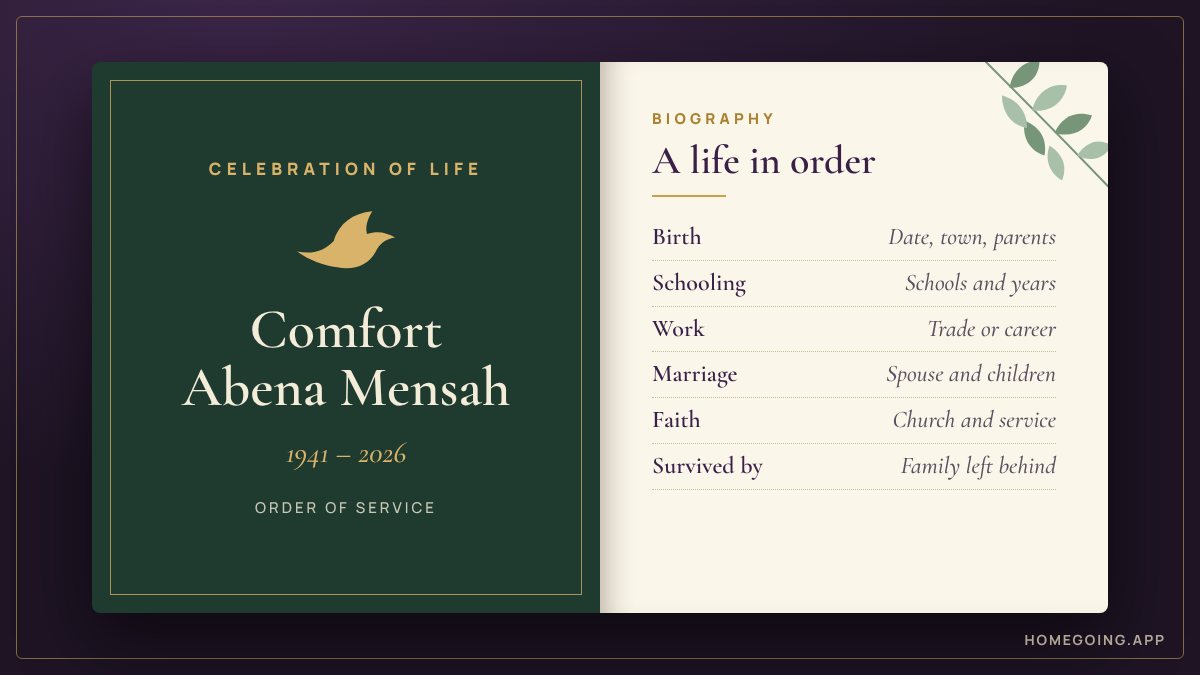
What a biography covers
A biography follows the life in order. Most families use these parts.
- Birth. The date, the town, and the names of the parents.
- Childhood and family. Position among the children, and where they grew up.
- Schooling. Schools attended, with years if the family is sure of them.
- Work. Trade, business or career, with the places and the main posts held.
- Marriage and children. When and whom they married, and the children.
- Faith. Church or mosque, and any service or office held there.
- Community. Titles, societies, town unions and other roles.
- Character. Two or three things everyone would agree on.
- Last days. When and where they died, and at what age.
- Survived by. Who is left behind.
You do not need every part. A short, true biography is better than a long one with guesses in it.
Collect the facts first
Do this before you write a word. Ask the oldest relatives, and write down who told you what.
- Full name, with titles, in the order the person used them
- Date and place of birth
- Parents' names
- Schools, jobs and places lived, with years where known
- Date of marriage, and the spouse's full name
- Church or mosque, and offices held
- Date and place of death
Where two relatives disagree on a date, leave the date out. "In the early 1970s" is honest. A wrong year in print will upset somebody.
Sample biography of a late mother
Replace the words in brackets with your own details. Take out any sentence that does not apply.
Biography of a late mother
Mrs (full name), fondly called (name she was known by), was born on (date) in (town), to the family of Mr and Mrs (parents' names). She was the (first, second, last) of (number) children.
She began her education at (primary school) and went on to (secondary school or training). After her schooling she worked as a (trade or job) at (place), and later (next stage of work or business).
In (year) she married (husband's name) of (town). The marriage was blessed with (number) children.
Mama was a devoted member of (church), where she served as (office or group) for (number) years. (One sentence on what she did there.)
She was known for (first quality). (One short example that shows it.) She was also (second quality), and (one more example).
She passed on peacefully on (date) at (place), aged (age) years. She is survived by (children, grandchildren, brothers and sisters).
Short biography of a late mother
Madam (full name) was born in (year) in (town). She was a (trader, farmer, seamstress, teacher) for most of her life, and was known in (town or market) for her honesty and her open hand.
She married (husband's name) and raised (number) children. She was a faithful member of (church or mosque).
She died on (date), aged (age), and is survived by her children, grandchildren and great-grandchildren.
Biography of a mother who served in the church
(Title, such as Deaconess or Elder) (full name) was born on (date) in (town) to (parents' names). She was baptised in (year) and confirmed in (year).
She trained as a (teacher, nurse, seamstress) at (place) and worked at (place) until (year). In (year) she married (husband's name), and they had (number) children.
Her life centred on (church). She joined the (choir, women's fellowship, guild) in (year) and served as (office) from (year) to (year). She (taught Sunday school, led the prayer group, cared for the altar) for (number) years.
At home she began and ended each day with prayer, and she taught her children to do the same.
She was called to rest on (date), aged (age). She leaves (number) children, (number) grandchildren and a church family that will miss her.
Sample biography of a late father
Biography of a late father
Pa (full name) was born on (date) at (town), in (local government or state), to the late (father's name) and the late (mother's name).
He attended (primary school) from (year) to (year), and (secondary school or college) afterwards. He then joined (employer) in (year) as a (first post), or learned (trade) under (master or firm). He rose to (last post) and retired in (year) after (number) years of service.
He married (wife's name) in (year). They were blessed with (number) children.
He was a member of (church or mosque), where he served as (office). In his community he was (title or role), and a member of (society or union).
Those who knew him will remember (first quality). (One short example.) He believed in (what he taught his children), and he lived by it.
He died on (date) at (place), at the age of (age). He is survived by his wife, (number) children, (number) grandchildren, and many relatives.
Short biography of a late father
Mr (full name) was born on (date) in (town). After (school or apprenticeship), he worked as a (trade or job) for (number) years.
He married (wife's name) in (year), and they had (number) children. He was a quiet, hard-working man who (one thing everyone knew him for).
He died on (date) at the age of (age). He is survived by his wife, his children and his grandchildren.
Biography of a father with a title or a public life
(Chief, Elder, Alhaji, Sir) (full name), the (title) of (town), was born on (date) into the (family name) family of (town).
He was educated at (schools) and qualified as a (profession) in (year). He worked with (employer) from (year) to (year), rising to (post). After retiring he (farmed, ran a business, served his town).
He received the title of (title) in (year). He served as (chairman, patron, president) of (union, society, club), and helped to bring (a school, a road, a clinic) to the town.
He married (wife's name) in (year) and was the father of (number) children.
He died on (date), aged (age). He is survived by (his wife, children, grandchildren, brothers and sisters).
A funeral biography sample written by the children
Most biographies say "she" or "he". When the children write it themselves, "our mother" and "we" are also right. Choose one and keep to it.
Biography in the children's own voice
Our (mother, father), (full name), was born on (date) in (town), the (first, second, last) child of (parents' names).
(She, He) did not have the chance to go far in school, and was determined that we would. (She, He) (traded, farmed, drove, sewed) for (number) years to pay our fees, and every one of us finished school.
(She, He) married our (father, mother), (name), in (year). We are (number) children, and (she, he) lived to see (number) grandchildren.
(She, He) left us on (date), aged (age). We are grateful to have been (her, his) children.
Biography phrases you can copy
Use these to build your own, one part at a time.
Birth and family
- (Name) was born on (date) in (town), to the family of (parents' names).
- Born in (year) in (town), (he, she) was the (first, last) of (number) children.
- (He, She) grew up in (town), where (his, her) father was a (job) and (his, her) mother a (job).
School and work
- (He, She) attended (school) from (year) to (year).
- (He, She) learned (trade) under (master) and opened (his, her) own (shop, workshop) in (year).
- (He, She) joined (employer) as a (first post) and retired as (last post) in (year).
- After retiring, (he, she) returned to (town) and took up (farming, trading, church work).
Marriage, faith and community
- In (year) (he, she) married (name) of (town), and the marriage was blessed with (number) children.
- (He, She) was a devoted (husband, wife) for (number) years.
- (He, She) was baptised at (church) in (year) and remained a member all (his, her) life.
- (He, She) served as (office) of the (society, union, association) for (number) years.
Last days and those left behind
- (He, She) passed on peacefully on (date) at (place), aged (age).
- After a short illness, (he, she) was called to rest on (date).
- (He, She) died at home on (date), with (his, her) family beside (him, her).
- (He, She) is survived by (his, her) (wife, husband), (number) children and (number) grandchildren.
- (He, She) leaves behind children, grandchildren, brothers, sisters and many relatives.
How long it should be
For a printed programme, one page is usual. That is about 300 to 450 words. An elder with a long public life may need two pages.
If the life was short, or the family knows little about the early years, write less. Three honest paragraphs are enough.
If the biography will also be read aloud, read it against a clock. Three to four minutes is plenty. Ask the minister or the master of ceremonies how long you have.
Writing it well
- Use plain words. "She sold cloth at Oja Oba for thirty years" tells people more than "she was an industrious businesswoman".
- Keep to the facts. Save feelings for the tributes. The biography says what happened. A tribute says what the person meant to you.
- Use one name throughout. Choose "Mama", "Mrs Ade" or the first name, and keep to it.
- Put titles right. Chief, Elder, Deaconess, Alhaji, Sir, Lady. Ask the family which to use and in what order.
- Do not rank the children. List them in order of birth.
Questions people ask
How do I write a biography of my late mother or father?
Collect the facts from the oldest relatives first. Then write them in order: birth, schooling, work, marriage and children, faith, character, last days and those left behind. Use plain words, and leave out any date the family is not sure of.
What is included in a funeral biography?
The full name and titles, the date and place of birth, parents, schools, work, marriage, children, faith and community roles, two or three qualities, the date of death and the age, and a list of those who survive. You do not need every part.
How long should a biography in a funeral programme be?
One page is usual, which is about 300 to 450 words. An elder with a long public life may need two pages. If it will be read aloud, three to four minutes is plenty.
What is the difference between a biography and a tribute?
The biography gives the facts of the life in order. A tribute is personal, and says what the person meant to the one who wrote it. In the programme, the biography comes first and the tributes follow.
Should the biography say how the person died?
That is for the family to decide. Many biographies give only the date, the place and the age. Leave out details of an illness unless the family has agreed to share them.
Check before printing
- Read every name aloud to a relative who knows the spelling.
- Check each date against a document if you can.
- Make sure the age matches the dates on the cover.
- Ask one person from each side of the family to read it.
- Agree the "survived by" list with the head of the family, because leaving someone out causes real hurt.
For more help with the writing, see how to write a life story for a funeral. For the personal pages, see tribute to my late mother, tribute to my late father and how to write a tribute. For the rest of the booklet, see what goes in a funeral programme.
Write it with Homegoing
Homegoing writes the biography from what the family tells it. You can type, talk, or paste notes, and relatives can add what they remember by link. It only uses the facts you give, and it shows you what to check before printing. Start a programme