If you are wondering how to write a tribute for a funeral, the hard part is usually that there is too much to say. A simple structure helps. This guide gives you five parts to fill in, tribute templates you can copy, funeral tribute examples for different relatives, and a few things to check before you send it.
What a funeral tribute is
A tribute is not the same as the biography. The biography gives the facts of a life. A tribute is personal. It says what this person meant to you. Several people may write one, and the tributes are printed after the biography in the funeral programme. Some are also read at the service.
First, find out what is needed
Before you write, ask whoever is putting the programme together:
- How long should it be? If nobody has set a limit, aim for 200 to 300 words for a printed tribute.
- When is the deadline?
- Will it be printed, read aloud, or both?
- Are the children writing one tribute together, or one each?
Where there are many children, a joint tribute with one or two lines from each can work well. Other families print a tribute from every child. Either is fine. Agree it early, so that nobody feels left out.
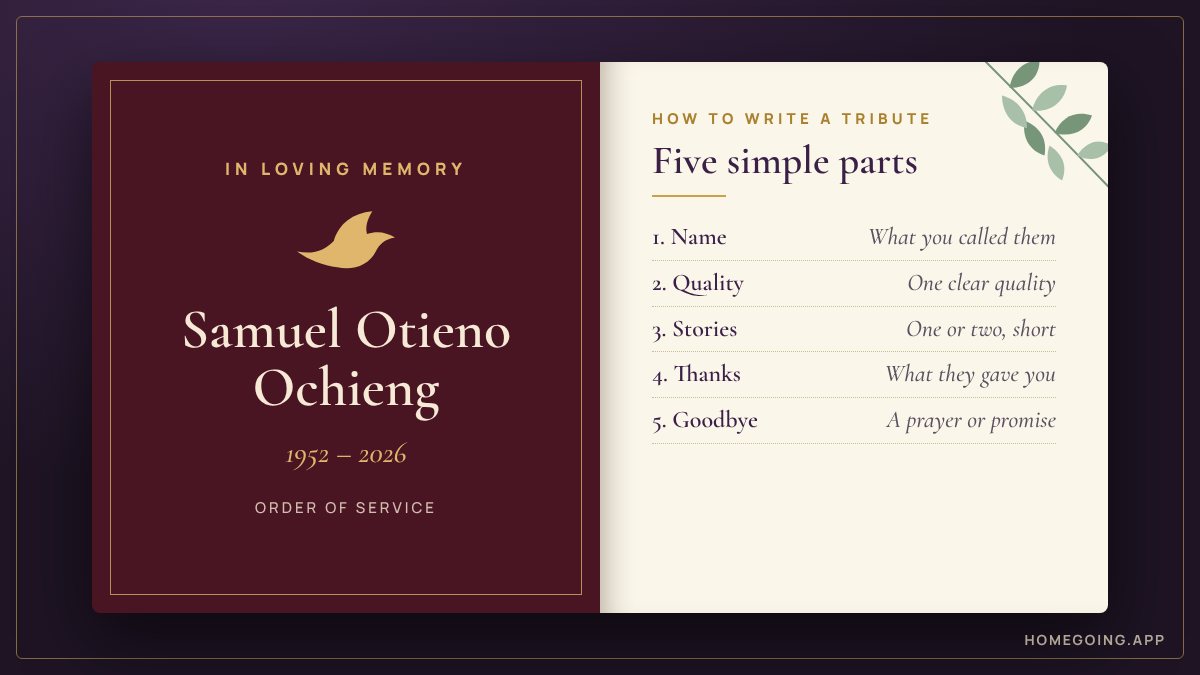
How to write a tribute in five parts
- Begin with the name you called them. Mummy, Dad, Papa, Grandma, Uncle. You may write to the person directly, or write about them. Choose one and keep to it.
- Name one quality. Pick the one thing that most made them who they were. Patience. Hard work. Faith. Laughter. One quality, clearly shown, is stronger than a list of ten.
- Tell one or two short stories. This is the heart of the tribute. Choose a moment that shows the quality: something they did every morning, a journey you made together, the way they handled a hard season. Keep each story to a few sentences.
- Say what they gave you. What did you learn from them? What do you do today because of them? This is the place to say thank you.
- Say goodbye. One or two lines. A farewell, a prayer, a promise, or a line of hope. Then sign with your name and, if you wish, your place in the family, such as "your first daughter".
That is all a tribute needs. If you fill in those five parts honestly, it will be good.
Tribute templates for a funeral
Copy a template and replace the words in brackets with your own.
A short tribute template
(Name you called them),
You were (one quality) to everyone who knew you. I will always remember (one small memory). Thank you for (what they gave you). Rest in peace.
(Your name), (your place in the family)
A full tribute template
My dear (name you called them),
When I think of you, the first thing I see is (something they did every day). That was you: (one quality), in small things and in great.
I remember (first short story: when, where, what they did or said). I also remember (second short story). At the time I did not understand (what it cost them, why they did it). I do now.
From you I learned (lesson). Because of you, I (something you do today). Thank you for (two or three things).
(Farewell: a prayer, a promise or a line of hope.)
(Your name)
(Your place in the family)
A joint family tribute template
To our dear (name),
We, your (children, brothers and sisters, nieces and nephews), thank God for your life.
(First name): "I will remember (one line)."
(Second name): "You taught me (one line)."
(Third name): "Thank you for (one line)."Together we promise to (stay united, look after one another, carry on what you began). Rest in peace.
(All names, in order of birth)
A tribute template for reading aloud
(Name) was my (relationship), and I am (your name).
If I had to choose one word for (him, her), it would be (quality). Let me tell you why.
(One story, told in five or six short sentences.)
That is who (he, she) was. (He, She) taught me (lesson), and I will carry it with me.
(Name), thank you. Rest in peace.
Funeral tribute examples
We have a full page of samples for each of these.
- Tribute to my late mother and tribute to my late father
- Tribute to a late husband or wife
- Tribute to a late brother or sister
- Tribute from grandchildren
- Tribute to a mother-in-law or father-in-law
- Tribute to a friend or colleague
- Tribute from a church to a member
The examples below are for other relatives.
Tribute to an uncle or aunt
Uncle (name),
You came to every school event when my father could not. You never arrived without (fruit, bread, a story), and you never left without pressing something into my hand.
You taught me to (drive, save, argue politely). When I made a choice that the family doubted, you were the one who spoke for me.
Thank you for being a second father. Rest well, Uncle.
Your (nephew, niece),
(name)
Tribute to a son or daughter
Our dear (name),
No parent expects to write these words. You were with us for (number) years, and you filled every one of them. You (sang in the bath, argued about football, looked after your little sister).
We do not understand why you had to go before us. We thank God that you were ours, and we will speak your name in this house every day.
Sleep well, our child.
Mummy and Daddy
Tribute to a teacher or mentor
(Title and name) taught me in (year) at (school). (He, She) was the first person outside my family to tell me that I could (go to university, write, lead). At the bottom of my work (he, she) once wrote a line that I still remember: "(words)".
Many of us stand where we are today because of (him, her). Thank you, (Sir, Ma). Rest in peace.
(Name), (class or year)
Short funeral tribute examples
- (Name), you were kind to everyone and proud towards no one. Thank you for your life. Rest in peace.
- Aunty, your house was my second home, and your advice was always right. Sleep well.
- Uncle, you treated your brother's children as your own. We will not forget it. Rest well.
- My cousin, my first playmate. Childhood was better because you were in it. Rest in peace.
- You taught me more than what was in the books. Thank you, (Sir, Ma).
- (Name), you were a good neighbour for (number) years. The street is poorer without you.
- To my godmother, who prayed for me from my first day. Thank you. Rest in the Lord.
- A life of service, quietly lived. Rest in peace, (name).
- Our dear (name), gone too soon and loved always. Sleep well.
- Thank you for everything, (name). Till we meet again.
Opening and closing lines for a tribute
Opening lines
- (Name), I do not know how to say goodbye, so I will begin with thank you.
- There is one thing everyone here knows about (name): (quality).
- The first thing I remember about you is (memory).
- (Name) was not a person of many words, but everything (he, she) did spoke loudly.
Closing lines
- Thank you for everything. Rest in peace.
- We will carry on what you began.
- Your work is done. Rest now.
- May God, who gave you to us, keep you until we meet again.
Finding the right stories
The best stories are small and exact. Think about:
- What you can still hear them say
- What they cooked, sang, mended or grew
- A time they corrected you, and were right
- A sacrifice you only understood later
- What they did when nobody was watching
- How they treated visitors, neighbours and strangers
If your mind is blank, look through old photos, or ask a brother or sister what they remember. One memory tends to bring another.
Avoid private jokes that only two people will understand, and stories that might embarrass someone in the room. A funeral programme is read by the whole family, the church and the neighbours, and it is kept for years.
When the relationship was not simple
Not every parent was easy to love, and not every child was close. You do not have to pretend. You also do not have to tell everything.
Look for what is true and can be said with respect. Perhaps they worked hard to pay school fees. Perhaps they softened in later years. Perhaps you made peace at the end. A short, honest tribute is better than a long one you do not mean. It is also acceptable to add your name to a joint family tribute and write nothing more.
If you will read it aloud
A tribute read in church has its own needs.
- Ask how many minutes you have. Read slowly, two to three minutes is around 300 to 400 words.
- Use short sentences. They are easier to say when your voice is unsteady.
- Print it in large type. Do not rely on a phone screen.
- Practise aloud at least twice, once in front of someone.
- Mark the places where you may need to pause.
- Ask someone to be ready to take over if you cannot finish. This is common, and nobody will mind.
The minister decides who speaks during the service and for how long. Some churches prefer tributes to be given at the wake keep, the vigil or the reception, not during the service itself. Ask before you prepare.
Questions people ask
How do you write a tribute for a funeral?
Begin with the name you called the person, name one quality, tell one or two short stories that show it, say what they gave you, and say goodbye. Sign it with your name and your place in the family.
How do you start a tribute?
Start with the name you called them, then one clear memory or the one quality everyone knew. For example: "Uncle, you never arrived at our house with empty hands."
How long should a funeral tribute be?
If nobody has set a limit, aim for 200 to 300 words for a printed tribute. A tribute read aloud for two to three minutes is around 300 to 400 words.
What is the difference between a tribute and a eulogy?
A tribute is short and personal, and several people may write one. A eulogy is one longer speech at the service, which also tells the story of the life.
Can I put a poem or a song in my tribute?
A long poem or the words of a song may be in copyright. It is safer to give the title, with a line of your own about what it meant to the person.
Check before you send it
- Are the names, places and years correct? They should match the life story in the same booklet.
- Is it within the word limit? If it is too long, cut a story, not the thanks.
- Have you copied out a long poem or the words of a song? These may be in copyright. The title, with a line of your own about what it meant to the person, is safer.
- Has one other person read it for spelling?
- Is your name written the way you want it printed?
Then send it on time. The person putting the programme together is often grieving too, and one late tribute can hold up the whole booklet. To see where tributes sit among the other pages, read what goes in a funeral programme.
Make the programme with Homegoing
With Homegoing, the family shares one link and relatives anywhere can add their tributes from a phone. The family approves each one before it goes into the booklet. Start a programme