In the United States the printed guide to a funeral is called the funeral program. In many Black churches it is the homegoing program, and it is a treasured family record. This guide gives you a funeral program template to follow page by page, funeral program examples for different kinds of service, and sample wording for the cover, the obituary and the back page.
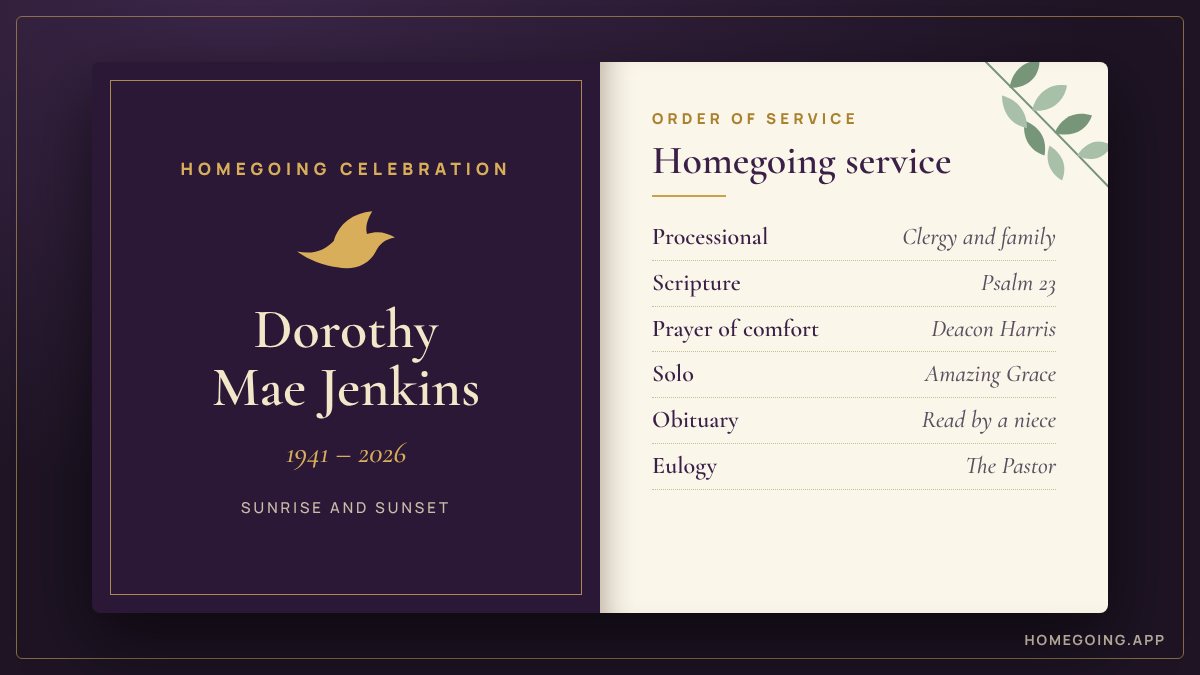
Funeral program template: page by page
Most funeral programs are a single letter-size sheet folded in half, which gives four pages. Larger families, and services with many photographs, often choose a small booklet.
A four-page funeral program
A four-page program can be laid out like this:
- Front cover
- Order of service
- Obituary
- Back cover, with pallbearers, interment, repast and the family's thanks
An eight-page booklet
In a booklet, the extra pages go to photographs, a poem, and tributes from the family. One way to set it out:
- Front cover
- Order of service
- Obituary
- Photographs
- Photographs
- Tributes from the children and grandchildren
- A poem or scripture, and the family's acknowledgement
- Back cover, with pallbearers, interment and repast
A stapled booklet is made of folded sheets, so the page count goes up in fours.
The cover
The cover needs:
- A photograph
- The full name, with any nickname the person was known by
- Dates of birth and death, often headed "Sunrise" and "Sunset"
- The date, time and place of the service
Headings vary. "In loving memory" and "Celebrating the life of" are common. For a homegoing, families often use "Homegoing celebration" or "Homegoing service".
Sample cover wording for a funeral program
In loving memory of
(FULL NAME)
"(Nickname)"Sunrise: (date of birth)
Sunset: (date of death)(Day, date), at (time)
(Church or funeral home)
(City and state)
(Title and name), officiating
Sample cover wording for a homegoing program
Homegoing celebration
for
(TITLE AND FULL NAME)Sunrise: (date of birth)
Sunset: (date of death)(Day, date), at (time)
(Church, with city and state)
(Title and name), Pastor
(Title and name), Eulogist
Sample cover wording for a memorial service program
Celebrating the life of
(FULL NAME)
(year of birth) to (year of death)Memorial service
(Day, date), at (time)
(Place, with city and state)
The order of service
The order of service lists each part of the service and who will lead it. A church service often includes:
- Prelude and processional
- Opening hymn or musical selection
- Scripture readings
- Prayer of comfort
- Solo or choir selection
- Remarks from family and friends
- Reading of the obituary
- Eulogy
- Closing prayer or benediction
- Recessional
Every church has its own order, and the officiating pastor has the final say. Ask the church office for their usual outline before you design anything. Then send the pastor your draft, with the readings, hymns and names of speakers, before it is printed. You can compare orders of service by church to see common patterns.
If several people will give remarks, agree a time limit with the pastor and print it beside the item. This saves awkwardness on the day.
A service at a funeral home, or a non-religious celebration of life, follows the same idea with fewer parts: music, a welcome, readings, memories and closing words.
Funeral program examples
Replace the words in parentheses with your own details. These are starting points. Your pastor's order comes first.
Example funeral program for a church service
Prelude: (name of the musician)
Processional: clergy and family
Opening hymn: (title)
Scripture: (Old Testament reference), read by (name)
Scripture: (New Testament reference), read by (name)
Prayer of comfort: (title and name)
Solo: (title), sung by (name)
Remarks from family and friends (two minutes each, please)
Reading of the obituary: (name)
Eulogy: (title and name)
Closing prayer and benediction
Recessional
Example homegoing program
Processional
Musical selection: (name of the choir)
Scripture: (Old Testament reference), read by (name)
Scripture: (New Testament reference), read by (name)
Prayer of comfort: (title and name)
Musical selection: (name of the choir or soloist)
Remarks: for the church, (name). For the family, (name). For friends, (name).
Acknowledgement of cards and resolutions: (name)
Reading of the obituary: (name)
Solo: (title), sung by (name)
Eulogy: (title and name)
Benediction
Recessional
Example program for a service at a funeral home
Music as guests arrive
Welcome: (name)
Reading: (title), read by (name)
Memories from family and friends
Musical selection: (title)
Closing words: (name)
Example memorial service program
Gathering music
Welcome: (name)
Reading or poem: (title), read by (name)
Life tribute: (name)
Memories from family and friends
Musical selection: (title)
A moment of silence
Closing words: (name)
A memorial service program is set out in the same way as a funeral program. Change the heading on the cover, and leave out the parts that do not apply, such as pallbearers and interment.
The obituary
The obituary is the life story. In a funeral program it is usually between about 250 and 500 words. It covers:
- Birth: date, place and parents
- Childhood and schooling
- Faith: their church, and how they served in it
- Marriage and children
- Work, military service if any, and achievements
- What they loved, and how people will remember them
- Death: the date, and often the place
- Survivors
The obituary ends with the survivors. This closing paragraph normally names the spouse, the children, and the brothers and sisters. It often gives the number of grandchildren and great-grandchildren, and ends with a line for other relatives and friends. Close relatives who died earlier are often listed too, with the words "preceded in death by".
Agree this list as a family before anyone writes it. Who is named, and in what order, can be sensitive. For help with the writing, see how to write a life story.
Sample obituary for a funeral program
(Full name), known to family and friends as (nickname), was born on (date) in (city and state) to (names of parents). (He, She) departed this life on (date) at (place).
(He, She) attended (school), and worked for (number) years as a (occupation) at (employer). (He, She) was a faithful member of (church), where (he, she) served as (role).
(He, She) married (name) in (year), and together they raised (number) children. (He, She) loved (fishing, cooking for a full house, a good hymn), and no visitor left the house hungry.
(He, She) was preceded in death by (names). (He, She) leaves to cherish (his, her) memory (spouse), (children), (number) grandchildren, (brothers and sisters), and a host of other relatives and friends.
For a longer example, see the sample biography of a late mother or father.
Homegoing programs
In the Black church, a funeral is often called a homegoing: a service that mourns a loss and celebrates a believer going home to God. The program reflects that. It is often longer, and full of photographs.
Alongside the pages above, a homegoing program may include:
- A page or more of photographs across the years
- Tributes or letters from the children and grandchildren
- A scripture or hymn they loved
- A poem
- Acknowledgement of cards, flowers and resolutions from churches and other groups
- The names of the ministers, musicians and soloists taking part
These programs are kept and passed down. Years later, they may be the only written record a family has of names, dates and places. That makes accuracy matter even more. Check maiden names, birthplaces and the spelling of every relative's name.
For the tribute pages, the samples in tribute to my late mother and tribute from grandchildren can be adapted.
The back page
The back of the program carries the practical details.
- Pallbearers. The people who carry the casket.
- Honorary pallbearers. People given a place of respect who do not carry it.
- Flower bearers. Those who carry the flowers.
- Interment. The name and place of the cemetery.
- Repast. Where the meal will be held after the service or the burial.
- Acknowledgement. A short note of thanks from the family for every prayer, call, visit and act of kindness.
Sample back page of a funeral program
Pallbearers
(names)Honorary pallbearers
(names)Flower bearers
(names)Interment
(Cemetery, with city and state)Repast
(Place and address), following the interment
Sample acknowledgement from the family
The family of (full name) thanks you for every prayer, call, visit, card and flower, and for every other act of kindness shown to us at this time. Your love has carried us. May God bless each of you.
A shorter acknowledgement
We are grateful for your prayers and your presence today. Thank you for sharing in the celebration of (name)'s life.
The (surname) family
A short poem often sits beside the family's acknowledgement. Many modern poems are still in copyright, so check before you print one in full. If you are still choosing music, see our list of funeral hymns, with the words of Amazing Grace and It Is Well with My Soul.
Scripture for the cover or back page
One verse under the photograph is enough. These are from the King James Version.
- 2 Timothy 4, verse 7. "I have fought a good fight, I have finished my course, I have kept the faith."
- Psalm 116, verse 15. "Precious in the sight of the Lord is the death of his saints."
- Psalm 30, verse 5. "Weeping may endure for a night, but joy cometh in the morning."
There are more in Bible verses for funerals.
Design and printing tips
- One clear photograph on the cover. Choose one with the face well lit.
- The name is the largest thing on the cover.
- No more than two typefaces, in a size older guests can read.
- Names beside each item in the order of service.
- Captions under photographs, with names and the year if you know it.
- A heavier paper. Ask the print shop for a paper thick enough that the print does not show through.
See funeral program size and printing for more on paper and the number of copies.
Before you print
- Have two family members proofread every name, date and title.
- Confirm the order of service, the scriptures and the speakers with the pastor.
- Check that each speaker and singer knows they are listed.
- Ask the funeral home or print shop for their deadline, and for a proof.
- Print extra copies. Relatives who could not travel will want one.
If a relative has been asked to write a tribute, share how to write a tribute. For the wording of the death notice, see funeral announcement wording.
Questions people ask
What is included in a funeral program?
The cover has a photograph, the full name, the dates and the details of the service. Inside are the order of service and the obituary. The back page lists the pallbearers, the interment and the repast, with the family's thanks.
What is the difference between a funeral program and an obituary?
The funeral program is the printed guide handed out at the service. The obituary is the life story. A short obituary is printed inside the program, which is why some families call it the obituary program.
What is a homegoing program?
It is the funeral program for a homegoing, the name many Black churches give to a funeral. It is often longer than other programs, with photographs, tributes from the family, and the names of the ministers and musicians taking part.
How many pages is a funeral program?
Most are four pages, made from one letter-size sheet folded in half. Families who want more photographs and tributes choose a booklet of eight pages or more.
What do you put on the back of a funeral program?
The pallbearers, honorary pallbearers and flower bearers, the place of interment, the place of the repast, and a short acknowledgement from the family. A short poem or a verse often sits beside it.
Is a memorial service program different from a funeral program?
It is set out in the same way. The cover says "Memorial service" or "Celebrating the life of", and parts that do not apply, such as pallbearers and interment, are left out.
Make the program with Homegoing
Homegoing is a website that makes a funeral program on your phone, with pages for the obituary, pallbearers, honorary pallbearers, flower bearers, repast and more. The finished booklet is a print-ready PDF in A5, a size close to a folded letter sheet, and there is a phone version to share with family far away. Start a programme