Planning a funeral from abroad, when a parent or relative has died back home, is hard, and the distance makes the grief heavier. You may not be able to travel at once, or at all. There is still a great deal you can do from where you are, and much of it is work the family at home will be glad to hand over. This guide gives you a checklist of jobs, and messages you can copy.
A checklist for the first few days
- Call home, and listen before you offer anything.
- Ask for a family call, and agree who decides and who does what.
- Choose one or two whole jobs that you can finish from where you are.
- Agree the budget, and say honestly what you are able to give.
- If you will travel, check your passport and any entry rules at once.
- Tell the family your arrival date before the schedule is fixed.
- Tell your employer, and ask what leave you may take.
Agree who decides and who does what
A funeral is led by the family at home, with the elders and the church. Relatives abroad help most when they support that, and do not try to direct it from a distance.
Early on, agree three things on a family call:
- Who speaks for the family. One person at home who deals with the minister, the funeral home or mortuary, and the family elders.
- Who holds the list. One person who keeps the list of tasks and dates, and knows who is doing each job.
- How decisions are made. Which matters need the whole family, and which can be left to the person doing the job.
Keep a small WhatsApp group for those doing the tasks, apart from the large family group. After each call, write the decisions down in one message, so that people in other time zones can catch up.
A message to arrange the family call
Good day, everyone. Can we hold a family call on (day, date) at (time, with the place, such as "7pm Accra time")? We need to agree who will speak for the family, who will keep the list of jobs, and the budget. Please reply with a time that suits you if this one does not.
A message after the call, with the decisions
Decisions from the family call of (date):
1. (Name) will speak for the family to the church and the mortuary.
2. (Name) keeps the list of jobs and dates.
3. Proposed date of the funeral: (date), to be confirmed with the church.
4. Programme and tributes: (name). Photographs: (name). Guests and travel: (name).
5. Next call: (day, date, time, with the place).If anything here is wrong, please tell (name) today.
Tasks that can be done from anywhere
Much of the paperwork of a funeral needs only a phone or a laptop. This is where the relative who is good with computers can lift a real weight.
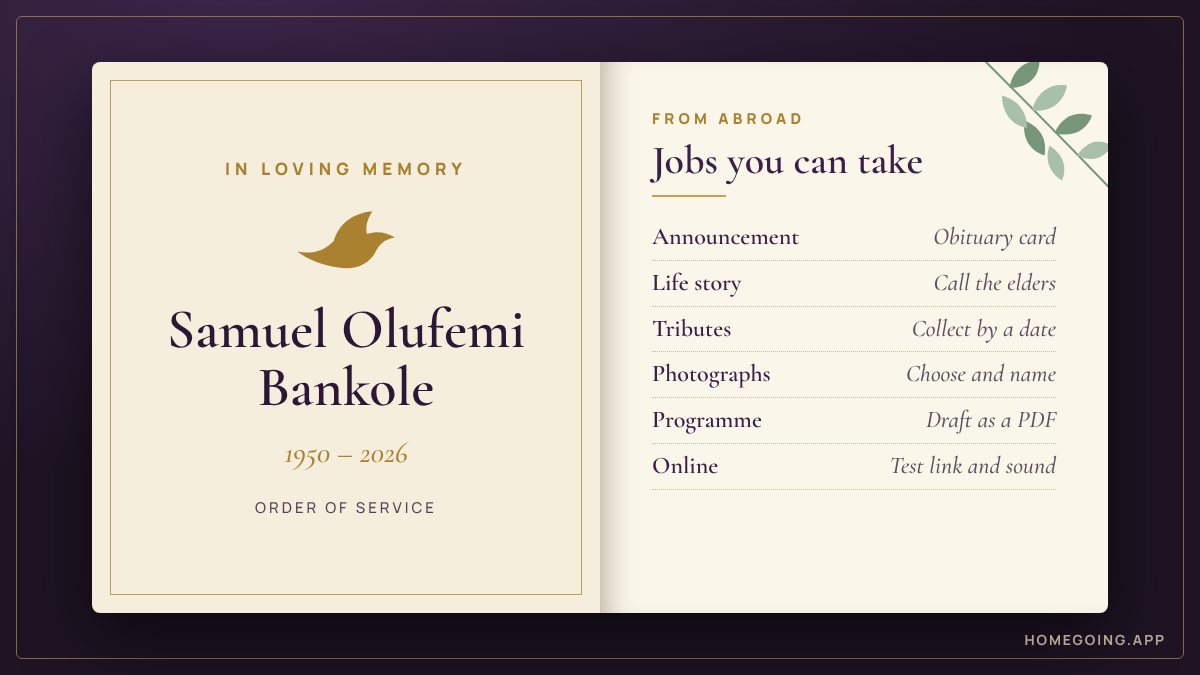
- The announcement. Prepare the obituary card once the family confirms the details. See funeral announcement wording.
- The life story. Call the older relatives, record what they remember, and write the first draft. See how to write a life story.
- Tributes. Send out the request, set the word limit and the deadline, remind people, and collect what comes in.
- Photographs. Gather pictures from relatives in every country, choose the clearest, and note who is in each one.
- The programme. Put the booklet together and send drafts round for checking. Our checklist of what goes in a funeral programme lists every page.
- Guests. Keep a list of who is travelling, and share directions, the dress code and the schedule.
Offer to take a whole job and finish it. That is worth more than a general offer of help.
A message offering to take a job
(Name), I cannot be there yet, but I would like to take the programme off your hands. I will collect the tributes and photographs, put the booklet together, and send you one draft to check. Please send me the minister's order of service when you have it.
A message asking for tributes
Dear family and friends, we are preparing the funeral programme for our late (father, mother), (title and full name). If you wish to write a tribute, please send it as typed text to (name) on (number) by (date). Kindly keep it to (number) words, and add your name as you want it printed. Thank you.
A message asking for photographs
Please send me your best photographs of (Daddy, Mummy) by (date). Send the photo itself, not a screenshot, so that it prints clearly. With each one, tell me the year, the place and who is in it.
Work closely with the people at home
Some things can only be done on the ground: meeting the minister, visiting the printer, choosing the burial place, receiving visitors. Your work has to fit around these.
- Ask the family contact for the minister's order of service before you design the programme. The officiating minister has the final say on the order, the readings, the hymns and the speakers.
- Ask the printer, through someone at home, what kind of file they need and how many days they need. Then set your own deadline a little earlier.
- Send drafts as a PDF, so that the pages look the same on every phone.
- Ask for one set of corrections from the family contact, not separate messages from ten people.
- Have two family members proofread names and titles before anything is printed.
- Be patient with slow replies. People at home may be receiving visitors all day.
Be careful with time zones. Put the place beside every time you mention, such as "8pm Lagos time" or "3pm London time".
Questions to send to the printer
Good day. Please help me to ask the printer these questions:
1. What kind of file do you need, and what page size?
2. How many days do you need to print (number) copies?
3. What is the last day we can send the file?
4. Can we see one sample copy before the full run?
5. What will it cost, for (number) pages in colour?
A message sending the draft for checking
Here is the draft programme as a PDF. Please read every name, title and date, and check the order of service with (title and name of the minister). Kindly collect all the corrections and send them to me in one message by (day, time, with the place).
The programme: who supplies each page
When you put the booklet together from abroad, each page depends on someone at home.
- Cover. The family chooses the photograph and confirms the full name, titles and dates.
- Arrangements. The family contact confirms each date, time and place.
- Order of service. The minister supplies it, with the readings and hymns.
- Life story. Written from what the older relatives remember, and agreed by the family.
- Tributes. Sent by each writer. The family decides the order.
- Family list. Agreed by the elders.
- Thanks. Worded by the family.
What families expect differs by country. See our guides to the Nigerian burial programme, the Ghana funeral brochure, and funeral programmes in Kenya and South Africa.
Money and records
Relatives abroad are often asked to contribute to the cost. This can strain a family if it is not handled openly.
- Agree a budget as a family before money is sent, and agree who will hold the funds.
- Send money in a way that leaves a record.
- Ask one person to keep a simple list of what came in and what was paid out, and to share it with the family afterwards.
Families have different customs about who pays for what. Follow the lead of the elders, and say honestly what you are able to give.
A message when you send money
(Name), I have today sent (amount) to (name of the person holding the funds) by (bank transfer, money transfer) as my contribution to the funeral. Please confirm when it arrives, and add it to the family record. Thank you for keeping the accounts.
If you cannot travel
Many people cannot get home in time. Work, cost, visas, health and family duties are all real limits. They are no measure of your love.
You can still take part.
- Ask whether the service will be shown online, and offer to arrange it with someone at home. Ask them to test the link, the sound and the phone signal at the venue beforehand.
- Ask for the watch-online link to be printed in the programme and shared in the family group.
- Send a written tribute, and ask a brother, sister or cousin to read it for you. See how to write a tribute.
- Ask for a copy of the programme as a PDF, so that you can follow the service page by page.
- Gather with family or friends where you live, and watch together.
If you will travel, check your passport and any entry rules at once. Tell the family your arrival date before the schedule is fixed.
A line for the programme about watching online
For family and friends who cannot be with us, the service will be shown online from (time, with the place) at (link).
A message inviting people to watch online
The funeral service of our (father, mother), (title and full name), holds on (day, date) at (time, with the place). If you cannot travel, you can watch here: (link). The programme is attached, so that you can follow each hymn and reading. Thank you for your prayers.
A tribute to be read for you
(Daddy, Mummy), I am sorry that I cannot stand beside you today. The miles between us never changed what you were to me. You called every (Sunday), and you ended every call with a prayer. I will keep that habit with my own children.
Thank you for all you gave so that I could go far. Wherever I live, I carry your name and your teaching. Rest in peace.
(Your name), read on my behalf by (name)
For longer samples, see tribute to my late mother and tribute to my late father.
If the death happened where you live
This guide is about a death back home. If your relative died abroad and will be buried at home, speak to a funeral director where the death happened as early as you can. They can tell you which papers are needed, how long it may take and what it will cost. Do not fix the date of the funeral at home until they have told you.
After the funeral
From abroad you can help to send thanks, share photographs, and keep a copy of the programme safe for the wider family. Call the ones who carried the most at home. They will be tired, and a call a few weeks later means a great deal.
A thank-you message to those at home
(Name), thank you for all you did for (Daddy, Mummy)'s funeral. You carried the heaviest part while we were far away, and you did it well. I will call you on (day). Please rest.
There is more wording in appreciation messages after a burial.
Questions people ask
How do I plan a funeral from abroad?
Start with a family call. Agree who at home speaks for the family, who keeps the list of jobs, and how decisions are made. Then take a whole job you can do from a phone or laptop, such as the announcement, the life story, the tributes or the programme.
What can I do if I cannot travel home for the funeral?
Ask whether the service will be shown online, and ask for the programme as a PDF so that you can follow it. Send a written tribute for a relative to read for you. Gather with family or friends where you live, and watch together.
How can family abroad help to pay for a funeral without quarrels?
Agree a budget as a family before any money is sent, and agree who will hold the funds. Send money in a way that leaves a record. Ask one person to keep a simple list of what came in and what was paid out, and to share it afterwards.
Who makes the decisions when part of the family lives abroad?
The family at home leads, with the elders and the church. Relatives abroad help most by supporting that. The officiating minister has the final say on the order of service.
How do I send a tribute if I cannot attend?
Write it as typed text, keep to the word limit, and send it by the deadline to the person collecting tributes. Ask a brother, sister or cousin to read it at the service if tributes are being read aloud.
How do I avoid mistakes in a programme made from abroad?
Send drafts as a PDF, and ask the family contact for one set of corrections. Have two family members proofread every name and title. Check the order of service with the minister before it goes to the printer.
Make the programme with Homegoing
Homegoing is a website that works on any phone, with no app to install, so the programme can be made from wherever you are. Relatives anywhere add tributes through one shared link, the family approves each one, and the finished booklet comes as a print-ready PDF and a phone version to share on WhatsApp. Start a programme