A funeral MC script is the set of lines the master of ceremonies uses to move the programme along gently, so that the family does not have to. If you have been asked to be the MC at a service of songs, a funeral reception or a memorial, this guide gives you sample lines for each part, three full scripts to adapt, and the preparation to do first.
What a funeral MC does, and does not do
At the church service, the officiating minister leads. The MC usually leads the service of songs, the tributes, and the reception afterwards. Ask the family and the minister which parts are yours.
A funeral MC is not an entertainer. You are there to introduce, to keep time and to keep order. The less people notice you, the better you have done.
The same person is called the master of ceremonies, the MC or the emcee. In Kenya, South Africa and some other places the name is programme director, and it is often printed at the top of the order of service. The job is the same.
Before the day
- Get the programme and read it twice. Mark the parts you lead.
- Learn the names. Ask how to say the name and titles of the person who died, the minister, the widow or widower, and every speaker. Write them the way they sound.
- Meet the family's contact person. Ask what the family wants, and what they do not want mentioned.
- Agree the timing. Know when the event must end.
- Ask about the speakers. How many tributes, in what order, and how long each may be.
- Check the microphone before guests arrive.
- Dress as the family asks, and soberly.
Master of ceremony script for a funeral, part by part
Replace the words in brackets with your own details.
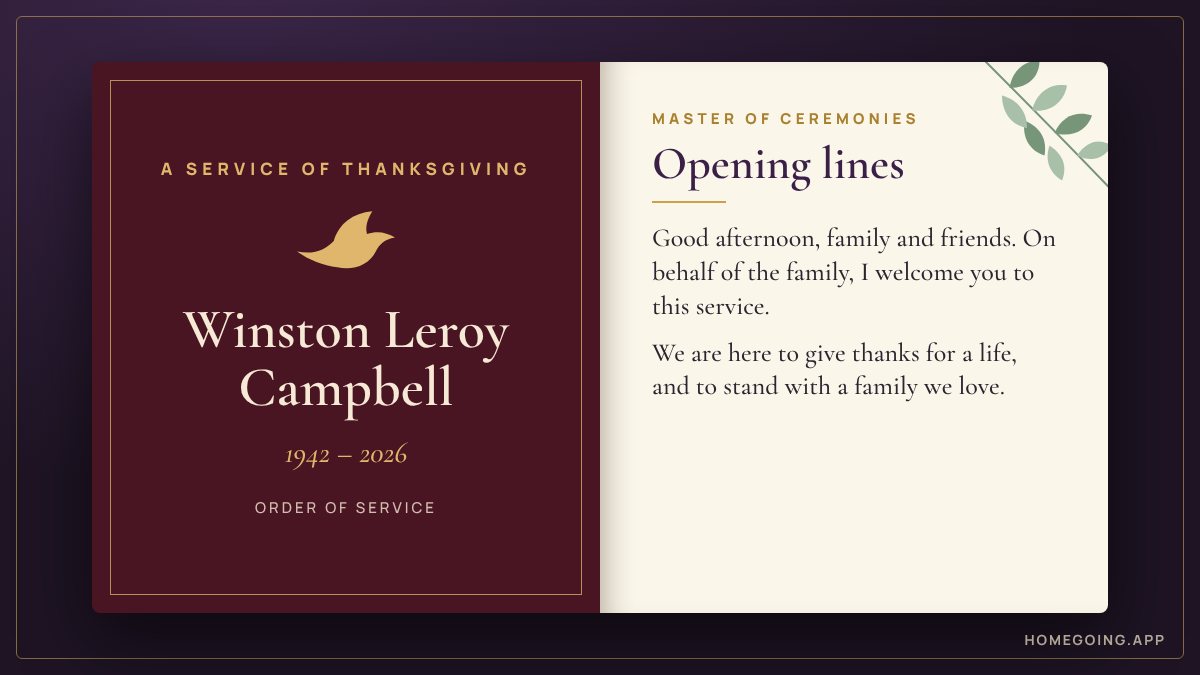
Opening lines
Good (afternoon, evening), family and friends. On behalf of the (surname) family, I welcome you to this (service of songs, reception) in honour of our beloved (title and full name).
My name is (name), and I will guide us through the programme. May I ask that phones be put on silent. Thank you.
We are here to give thanks for a life, and to stand with a family we love. I invite (title and name) to lead us in the opening prayer.
Welcoming guests and groups
The family is honoured by the presence of the officiating ministers, our elders, and the members of (church, society, workplace). We also welcome those who have travelled from (towns, countries), and those joining us online. You are all welcome.
Ask the family beforehand which guests and groups to name, and in what order. If the list is long, name groups and not each person.
Introducing a hymn or a reading
We shall now sing hymn number (number), "(title)". The words are on page (number) of your programme. Please stand if you are able.
The first reading is taken from (book and chapter). It will be read by (name), (relationship to the person).
Introducing the biography
We will now hear the story of the life we have come to honour. The biography will be read by (name), (relationship).
Introducing tributes
We come now to the tributes. Several people will speak, and the family has asked each to keep to (two, three) minutes, so that everyone may be heard.
The first tribute is from the children, given by (name).
Thank you, (name). Next, a tribute on behalf of (church, society, colleagues), given by (title and name).
Say the name and the group, and nothing more. Do not add your own comment after each speaker. A simple "thank you" is enough.
A musical item or a moment of silence
We will now listen to a song by (the choir, name). Please remain seated.
May I ask us all to stand, if you are able, for one minute of silence in memory of (name). (Pause.) Thank you. Please be seated.
Handing over to the minister
At this point I hand over to (title and name), who will lead us in the (exhortation, prayers, service).
Keeping time kindly
This is the hardest part. Tell every speaker the limit before the event, and where you will stand.
If someone runs long, step forward quietly and stand where they can see you. If they continue, wait for a pause and say:
Thank you very much, (name). The family is grateful for those words.
If many people still wish to speak:
The family thanks everyone who wished to pay tribute. There are many written tributes in the programme, and I encourage you to read them. We must now move on.
If someone breaks down
Give them a moment. If they cannot go on, step beside them and say:
Thank you, (name). We feel it with you. Please take your seat, and we will keep your words in our hearts.
Then move to the next item without comment. Never joke about tears.
Lines for when things do not go to plan
- A late start. "Thank you for your patience. We will begin now, and we will keep to time."
- A speaker is absent. "We will come back to that tribute. Let us move to the next item."
- The microphone fails. Stop, wait for it to be fixed, and say: "Thank you for bearing with us. We continue."
- Noise at the back. "May I ask for quiet, out of respect for the family. Thank you."
- The programme is running late. "With the family's agreement, we will take the remaining tributes as read. They are printed in your programme."
At the reception
Family and friends, the (surname) family thanks you for coming. Please be seated. Grace will be said by (title and name), after which refreshments will be served, table by table.
During the reception, the MC may recognise groups, announce the vote of thanks, and direct people. Keep announcements few and short. If there is music, agree with the family beforehand what is suitable.
Announcements
A few short announcements from the family. (Refreshments are served at the back of the hall. The family will receive guests at the high table. Guests travelling to (place) should leave by (time).) Thank you.
Closing remarks
We have come to the end of the programme. On behalf of the (surname) family, I thank the officiating ministers, the choir, and every one of you for your presence, your gifts and your prayers.
The vote of thanks will now be given by (name).
After the vote of thanks:
I invite (title and name) to say the closing prayer. After the prayer, please (remain seated for the recession, join the family at the reception at (place)). I wish you all a safe journey home.
A full funeral MC script for a service of songs
Follow the printed order. This script gives you a line for each item. For the order itself, see service of songs programme.
Good evening, and welcome. On behalf of the (surname) family, I welcome you to this service of songs in honour of (title and full name). My name is (name). Please put your phones on silent.
Let us rise for the opening hymn, "(title)", on page (number).
I invite (title and name) to lead us in the opening prayer.
The (choir, praise team) will now lead us in praise and worship.
The first reading, from (book and chapter), will be read by (name).
We will now hear the biography, read by (name).
We come to the tributes. Each speaker has (three) minutes. First, the children, given by (name).
Thank you. The choir will now sing.
I hand over to (title and name) for the exhortation and the prayers for the family.
Thank you, (title). The vote of thanks will be given by (name).
The funeral service holds tomorrow at (time), at (church). Let us rise for the closing hymn, after which (title and name) will give the benediction. Travel safely.
A programme director's script for a memorial service
Use this where one person guides the whole memorial and calls each speaker.
Good (morning, afternoon). My name is (name), and I am the programme director today. On behalf of the (surname) family, welcome to this memorial service for (title and full name).
The family has asked that each speaker keeps to the time printed in the programme. I will remind you gently if needed.
We open with a hymn, "(title)", and a prayer by (title and name).
I call on (name) to read the life story.
We will now hear from those who knew (him, her). First, (name), who speaks for the family.
Next, (name), on behalf of (workplace, colleagues).
Next, (name), on behalf of (church, community, friends).
Thank you to all who have spoken. I invite (title and name) to give the sermon.
The vote of thanks will be given by (name).
We close with the hymn "(title)" and the benediction. Please join the family for refreshments at (place).
A short MC script for the reception
Family and friends, please be seated. I am (name), and I welcome you on behalf of the (surname) family.
Grace will be said by (title and name).
Refreshments will be served table by table. Please stay in your seats and you will be attended to.
While we eat, the family will come round to greet you.
May I have your attention. The vote of thanks will be given by (name).
The closing prayer will be said by (title and name). Thank you for coming, and travel safely.
What an MC should never say
- The cause of death, unless the family has spoken of it publicly
- Anything about family disagreements
- Jokes about death, age or the widow or widower
- Comments on who gave what
- Praise for one family member over another
- Long stories of your own
If you are unsure whether to say something, leave it out.
A short checklist for the day
- The programme, with your parts marked
- The list of speakers, in order, with how to say each name
- A watch you can see without looking at your phone
- Water
- The phone number of the family's contact person
- A pen
For the wider plan, see how to plan a burial ceremony. For the thanks at the end, see vote of thanks at a funeral. Speakers who need help can use how to write a tribute. For a timed order with a programme director, see funeral programmes in Kenya and South Africa.
Questions people ask
What does an MC say at a funeral?
The MC welcomes the guests on behalf of the family, introduces each hymn, reading, tribute and speaker by name, keeps the programme to time, and thanks everyone at the close. The lines are short and plain. A simple "thank you" after each speaker is enough.
How do you start a funeral programme as an MC?
Greet the gathering, welcome them on behalf of the family, name the person being honoured, give your own name, and ask for phones to be put on silent. Then invite the minister or an elder to say the opening prayer.
What is the difference between an MC and a programme director?
They are two names for the same job. Programme director is the usual name in Kenya, South Africa and some other places, where the name is often printed at the top of the order of service.
Does the MC lead the church service?
Usually not. At the church service, the officiating minister leads. The MC usually leads the service of songs, the tributes and the reception. Ask the family and the minister which parts are yours.
How do you stop a speaker who talks for too long?
Tell every speaker the limit before the event. If someone runs long, step forward and stand where they can see you. If they continue, wait for a pause and say, "Thank you very much. The family is grateful for those words."
What should a funeral MC wear?
Dress as the family asks, and soberly. If the family has chosen a colour or cloth for the day, ask the family's contact person whether you should wear it.
A clear programme helps the MC
A master of ceremonies can only keep order if the programme is clear. Homegoing sets out the order of service line by line, with the name of each reader and speaker, and prints the hymn words in full. Start a programme