A burial checklist is a written list of every job, with a name and a date beside each one. Planning a burial is many small jobs done by tired people in a short time. A written checklist stops things being forgotten, and makes it easier to share the work. This guide sets out the jobs in order, with a budget list, a jobs sheet and a worked four-week plan to copy. Customs differ by family, church and town, so use it as a starting point and ask your elders what applies to you.
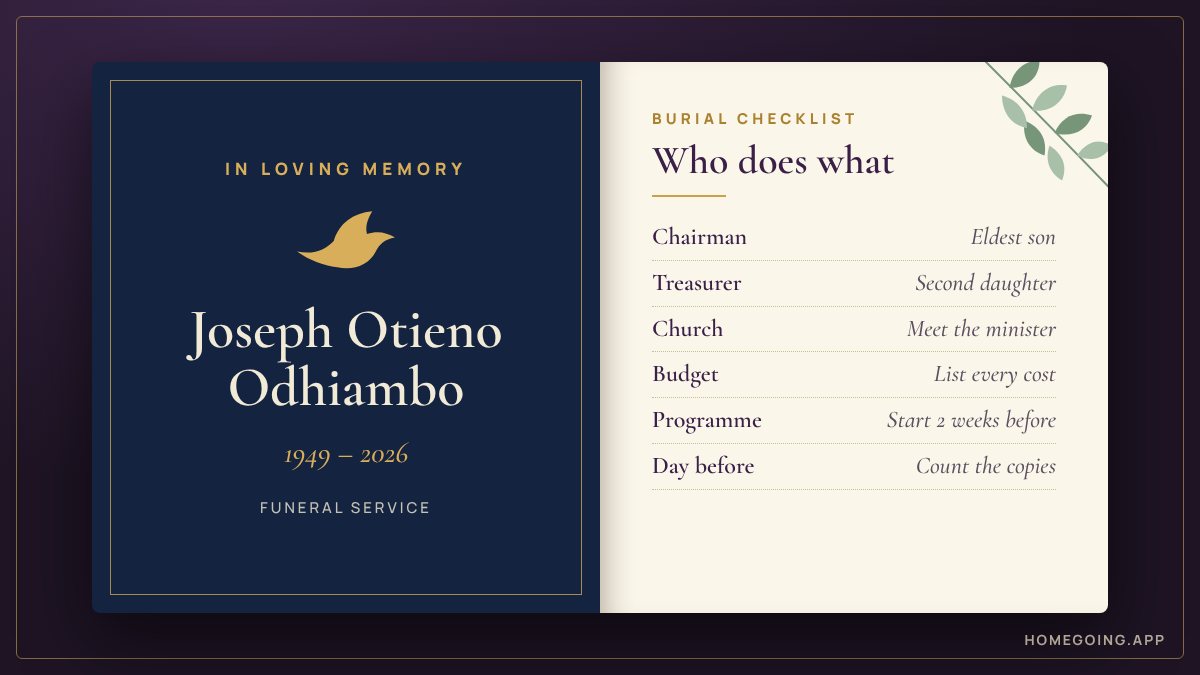
The funeral planning checklist at a glance
- Do what is needed in the first days.
- Decide who decides.
- Set the budget.
- Fix the dates.
- Meet the church.
- Announce and invite.
- Prepare the printed programme.
- Plan the service of songs or wake.
- Arrange for guests and practical things.
- Choose the people for the day.
- Check everything the day before.
- Finish well after the burial.
Each step is set out below as a list you can tick.
Step 1: In the first days
- Tell the closest relatives, in person or by phone, before anyone posts online.
- Tell the person's church, mosque or place of worship.
- Arrange for the body to be cared for, at a mortuary or funeral home.
- Find any wishes the person left: where to be buried, which church, which hymns.
- Get the documents your area requires, such as a medical certificate of death. Ask the hospital or the local office what is needed.
- Hold a first family meeting.
An agenda for the first family meeting
FAMILY MEETING
(Day, date, time), at (place) or on (video call)1. Opening prayer
2. What has been done so far
3. The wishes (he, she) left
4. Who will be chairman and treasurer, and who will write down the decisions
5. Where the burial will be, and likely dates
6. The budget, and what each person can give
7. Jobs, with a name and a date for each
8. Date of the next meeting
9. Closing prayer
Step 2: Decide who decides
Most disagreements at burials are about who has the final say. Settle this early.
- Name one person as chairman of the planning, and one as treasurer. They should be two different people.
- Agree who speaks for the family to the church and to the wider family.
- Write down each decision and share it in the family WhatsApp group, so that nobody says later that they were not told.
- Give each job to a named person, with a date.
A jobs sheet to copy
WHO DOES WHAT
Chairman: (name)
Treasurer: (name)
Church and minister: (name)
Mortuary, casket and grave: (name)
Announcement and invitations: (name)
Printed programme: (name)
Service of songs: (name)
Canopies, chairs, sound and power: (name)
Food and drink: (name)
Transport and accommodation: (name)
Photographs and online link: (name)
Contact person on the day: (name and number)
A message to share after each meeting
Family, these are the decisions from today's meeting.
Burial date: (day, date), at (place), subject to the church confirming.
Chairman: (name). Treasurer: (name).
Contributions are due by (date), to (name).
Jobs: (name), programme. (name), food. (name), canopies and chairs.
Next meeting: (day, date, time).
Step 3: Set the budget
Decide what you can spend before you decide what to do.
- List the costs: mortuary, casket, grave or vault, transport, church fees, canopies and chairs, food and drink, music, printing, photography, cloth, accommodation for guests.
- Agree what each family member will give, and by when.
- Keep every receipt. The treasurer should report at each meeting.
- Leave a part of the budget for things you did not expect.
A simple, well-ordered burial honours a person as much as a costly one.
A burial ceremony budget list
Copy this list, get a price for each line, and write beside it who has paid. Leave out the lines you do not need.
BURIAL BUDGET
Mortuary: (amount)
Casket: (amount)
Grave or vault: (amount)
Transport, including the hearse: (amount)
Church fees: (amount)
Canopies, chairs and tables: (amount)
Food and drink: (amount)
Music and sound: (amount)
Printing of programmes, posters and cards: (amount)
Photography and online link: (amount)
Cloth: (amount)
Accommodation for guests: (amount)
Set aside for the unexpected: (amount)Total needed: (amount)
Total promised: (amount)
Still to find: (amount)
The treasurer's report
Received so far: (amount), from (names).
Spent so far: (amount). Receipts are with me.
Balance in hand: (amount).
Still to pay: (items and amounts).
Still expected: (names and amounts, with dates).
If the total needed is more than the total promised, cut the plan before you spend. Look first at food, cloth, music and the number of printed pages.
Step 4: Fix the dates
- Ask the minister which dates the church has free.
- Check with the cemetery or the family compound.
- Ask the key relatives, especially those abroad, when they can travel.
- Avoid clashing with major holidays and other family events where you can.
- Do not announce a date until the church and the venue have both confirmed it.
If much of the family lives overseas, see planning a funeral from abroad.
Step 5: With the church
- Meet the officiating minister early.
- Ask what the church requires, and what it does not allow.
- Agree the order of service, the hymns and the readings. The minister has the final say.
- Ask about the choir, the organist and any fees.
- Ask how long the service may be, and how many tributes may be read.
See our orders of service for a first draft to take to the minister.
Step 6: Announce and invite
- Send the first announcement once the family has agreed the wording. See funeral announcement wording.
- Send the full invitation when the dates are confirmed. See burial invitation card.
- Write to the societies, clubs, employer and old students' groups.
- Visit or call the elders and in-laws who expect to be told in person.
Step 7: The printed programme
Start this at least two weeks before the burial. Printing always takes longer than expected.
- Choose one person to put it together.
- Gather the facts for the biography from the oldest relatives.
- Ask for tributes, with a word limit and a firm deadline.
- Choose a clear cover photo, and photos for the picture pages.
- Agree the names for the "survived by" list with the head of the family.
- Have two people read the whole draft.
- Show the order of service to the minister before printing.
- Order the copies, and ask for one proof first.
See what goes in a funeral programme and funeral programme size and printing.
Step 8: The service of songs or wake
- Agree the place, the time and who will lead.
- Arrange chairs, lights, sound and power.
- Choose hymns the gathering can sing.
- Limit the tributes.
See service of songs programme.
Step 9: Guests and practical things
- Canopies, chairs and tables, and who sets them up
- Food and drink, and who serves
- A generator, fuel and a working microphone
- Parking, and people to direct cars
- Somewhere for older guests to sit in the shade
- Toilets and water
- Accommodation and transport for relatives who travel
- A photographer, and a link to watch online if relatives abroad cannot come
- Security for the compound and the cars
Where a funeral home or a hired hall is handling part of the day, ask for a written list of what is included. Plan the rest from this list.
Step 10: People for the day
- A master of ceremonies who can keep time. See the funeral MC script.
- Readers for the lessons, told in advance
- Pallbearers
- Ushers at the church and the reception
- Someone to give the vote of thanks. See vote of thanks at a funeral.
- One person who holds the programme of the day and can answer questions, so that the bereaved are left in peace
Step 11: The day before
- Confirm the times with the church, the cemetery and the caterer.
- Collect the printed programmes and count them.
- Check the grave or vault.
- Brief the master of ceremonies and the ushers.
- Charge phones, and share the contact numbers.
- Rest. The family will need its strength.
Step 12: After the burial
- Thank the minister, the church and everyone who helped. See appreciation message after a burial.
- Hold the thanksgiving service, if your church has one.
- Pay every outstanding bill, and let the treasurer give a final account.
- Return anything borrowed or hired.
- Deal with the person's papers, accounts and belongings. For anything about property or a will, get advice from a lawyer.
- Look after the widow, widower and children in the quiet weeks that follow. That is when they need the family most.
A worked example: a burial planned in four weeks
This is one way to spread the jobs when the family has four weeks. It is an example only. Where the burial must be sooner, do the same jobs in the same order, and keep the programme short.
Four weeks before
- Hold the first family meeting. Name the chairman and the treasurer.
- Write the budget list and agree the contributions.
- Meet the minister. Ask for dates.
- Check the cemetery or the family compound.
Three weeks before
- Confirm the date with the church and the venue, then send the invitation.
- Write to societies, clubs and the employer.
- Book canopies, chairs, food, sound and transport.
- Ask for tributes and photos, with a deadline one week away.
Two weeks before
- Start the printed programme. Write the biography.
- Agree the order of service, hymns and readings with the minister.
- Agree the "survived by" list with the head of the family.
- Choose the master of ceremonies, readers, pallbearers and ushers.
One week before
- Have two people read the programme. Show the minister. Check one proof, then print.
- Confirm numbers with the caterer.
- Plan the service of songs.
- Let the treasurer report, and pay deposits that are due.
The last two days
- Collect and count the programmes.
- Check the grave or vault, the sound and the power.
- Brief the master of ceremonies and the ushers.
- Rest.
Questions people ask
What is the first thing to do when planning a burial?
Tell the closest relatives and the person's place of worship, arrange for the body to be cared for, and look for any wishes the person left. Then hold a first family meeting to choose a chairman and a treasurer.
What should be on a burial ceremony budget list?
Mortuary, casket, grave or vault, transport, church fees, canopies and chairs, food and drink, music, printing, photography, cloth and accommodation for guests. Add a line for things you did not expect, and write beside each line who will pay.
Who should be in charge of planning a burial?
Name one person as chairman of the planning and a different person as treasurer. Agree who speaks for the family to the church and to the wider family, and give every other job to a named person with a date.
When can we announce the burial date?
Only when the church and the venue have both confirmed it. Before that, the family can announce the death and say that the arrangements will follow.
When should we start the funeral programme?
At least two weeks before the burial. Collecting the tributes and photographs takes the longest, and printing always takes longer than expected.
How do we keep the cost of a burial down?
Decide what you can spend before you decide what to do, and keep every receipt. If the budget is short, look first at food, cloth, music and the number of printed pages. A simple, well-ordered burial honours a person as much as a costly one.
Make the programme with Homegoing
Homegoing takes one job off the list. The family tells it about their loved one, and it writes the life story, sets out the order of service, gathers tributes by link and lays out the booklet ready for the printer. Start a programme